
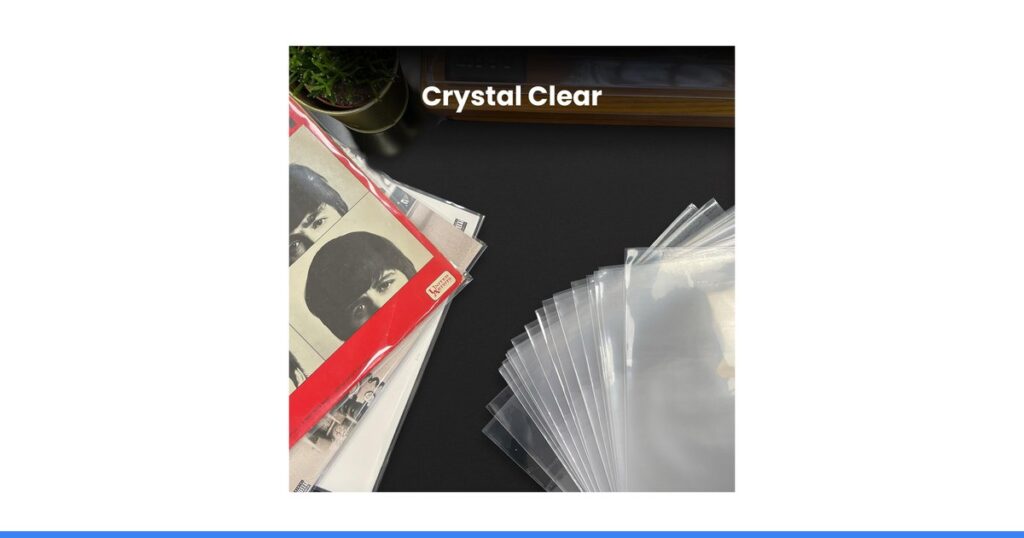
Three packs of outer sleeves for 12-inch records, and all three print the same number on the box: 3 mil thick. Across 30,705 buyer ratings, thickness comes back a praised theme on two of these three records, is absent from the third, and is disputed on none of them. Nobody is arguing about the mil figure. So if the number every seller advertises is not what separates these sleeves, something else is – and it turns out to be a word that only one of the three listings bothers to explain.
The claims, and what the record says
| The number | What it promises | What buyers report |
|---|---|---|
| EVEO 100 Outer Vinyl Record Sleeves | 3 mil polypropylene, 12.75in square, anti-static and acid-free | Clarity PRAISED at 124. Durability MIXED at 210 |
| Invest In Vinyl 100 LP Outer Sleeves | 3 Mil. polyethylene, 12.75 x 12.5in, a flush cut with no excess plastic | Durability PRAISED at 575. Clarity MIXED at 227, fit MIXED at 815 |
| Big Fudge 12in Outer Sleeves, 50 Pack | 3 mil high-density polypropylene, 12.75in square, 50 to a pack | Clarity PRAISED at 425, fit PRAISED at 600. Durability MIXED at 600 |
How We Check a Claim
We read the review record rather than the star rating. A praised theme is one buyers agree is good; a mixed one is where they contradict each other. Everything is counted per 1,000 buyers, and on this page that counting turned up something we have not seen in 63 comparisons – see the last paragraph. We also read every gallery image at full resolution, which is the only reason two of the findings here exist: one listing’s material claim, and one listing’s arithmetic.
Myth 1: EVEO 100 Outer Vinyl Record Sleeves

The smallest crowd on the page and the same pair of verdicts as the other polypropylene sleeve: buyers agree it is clear and disagree about whether it holds together. Thickness is praised at 85 – nobody here argues about the mil figure.
What the listing promises
Its title and its bullets both publish 3 mil, and its bullets and its own pack both name high-density polypropylene. It also sells 12.75 by 12.75 inches, anti-static treatment and acid-free construction, and describes itself as crystal clear yet extra thick. Its pack carries three roundels reading EXTRA THICK, SUPER STRONG and CRYSTAL CLEAR.
What the review record says
4.7 stars from 4,633 ratings with 84% of buyers at five stars. Six themes praised: quality at 393 mentions, value for money at 162, clarity at 124, size at 122, functionality at 91 and thickness at 85. Two disputed, both mixed: durability at 210, where buyers report seams splitting while putting the sleeves on, and fit at 196. Ratio 2.41. Note the SUPER STRONG roundel on its pack against that durability figure – the record does not agree, it argues.
What to check instead
Read its clarity and its seams together. They are the two halves of the same material choice, and this record shows both.
Seen on EVEO 100 Outer Vinyl Record Sleeves (example product) — 4.7 stars from 4,633 ratings.
Myth 2: Invest In Vinyl 100 LP Outer Sleeves

The only polyethylene sleeve here, and the only one whose durability is a compliment rather than an argument. It is also the only one whose clarity is argued about – buyers use the word cloudy, which is the word a rival listing uses about polyethylene.
What the listing promises
Its title and bullets publish 3 Mil., and its second bullet is the only place on this page where a seller names its own polymer as polyethylene. It measures 12.75 by 12.5 inches, the shortest sleeve here, and its third bullet sells a PERFECT FIT with a flush cut opening and “no excess plastic at the top of the poly sleeve after inserting the record”.
What the review record says
4.8 stars from 12,058 ratings – the highest rating on this page – with 86% at five stars and 1% at one. Six themes praised: value for money at 765 mentions, durability at 575 where buyers say it holds thicker gatefold records without tearing, protection at 440, functionality at 391, compatibility at 282 and thickness at 259, the deepest thickness praise here. Two disputed: fit mixed at 815 – the largest single theme on this page, on a listing that sells a perfect fit – and clarity mixed at 227. Ratio 2.60.
What to check instead
Its two disputes are the two things its own bullets lead on: the fit and the clarity. Read those bullets against those numbers.
Seen on Invest In Vinyl 100 LP Outer Sleeves (example product) — 4.8 stars from 12,058 ratings.
Myth 3: Big Fudge 12in Outer Sleeves, 50 Pack

The biggest crowd here and the best record by a distance – seven praised themes against one. It is also the listing that explains the polymer, naming polyethylene as the material that clouds, and the listing whose own gallery gets the thickness unit wrong.
What the listing promises
Its bullets publish 3 mil and its box prints “HIGH-DENSITY POLYPROPYLENE – 3 MIL THICK”. Its first bullet is the one this page turns on: the sleeves are “transparent and don’t cloud easily unlike industry standard sleeves that are made from polyethylene”. But one of its gallery images points a label at that same box and reads “3 MM” – about forty times thicker than 3 mil. Five of its six gallery images are in German on a US listing, which is where the mismatch sits.
What the review record says
4.7 stars from 14,014 ratings, the biggest crowd on this page, with 85% at five stars. Seven themes praised: quality at 1,300 mentions, fit at 600 – the only fit theme here that is not disputed – appearance at 440, clarity at 425 which is the deepest clarity praise on the page, functionality at 388, value for money at 379 and protection at 249. One theme disputed: durability, mixed at 600, with buyers reporting tearing at the seams. Ratio 6.30, more than double either rival.
What to check instead
Its bullet about polyethylene turned out to point the right way on this page. Note that, and note that its own gallery cannot spell its thickness consistently. Both are true of the same listing.
Seen on Big Fudge 12in Outer Sleeves, 50 Pack (example product) — 4.7 stars from 14,014 ratings.
What to Read Instead
Start with what the number does not do. All three of these sleeves advertise 3 mil – two of them in the product title as well as the bullets – and thickness is praised on the Invest In Vinyl at 259 mentions and the EVEO at 85, absent from the Big Fudge record, and disputed on none of the three. Whatever is separating these packs, it is not the figure they all share. What separates them is the polymer. By their own bullet points, Big Fudge and EVEO are polypropylene and Invest In Vinyl is polyethylene – and only Big Fudge explains the difference, in a bullet that says its sleeves are transparent and “don’t cloud easily unlike industry standard sleeves that are made from polyethylene”. It names the rival material. Then read the records: clarity is a praised theme on both polypropylene sleeves, 425 mentions and 124, and a mixed one on the polyethylene sleeve at 227, where its summary says buyers are split between finding them perfectly clear and describing them as cloudy. That is the word the rival bullet used. We are reporting an alignment, not a mechanism – three products cannot show that the plastic causes the clarity, and a seller being right about its competitor is not the same as a seller being right. And it is a trade, not a win. Durability runs the other way. It is mixed on both polypropylene sleeves – 600 mentions and 210, and both sets of buyers name the same failure, the seams tearing or splitting – and praised outright on the polyethylene one at 575, where buyers say it holds thicker gatefold records without tearing. Two attributes, swapping sides, on the material line. We have found attributes swapping before, in our drive enclosure comparison, and across our pages at least two themes go both ways more often than not – so the shape is not the news. The news is what they swap across. Two more things. The other number these listings publish does not work either: Big Fudge and EVEO print identical dimensions, 12.75 by 12.75 inches, and land on opposite sides of fit – praised at 600 on one, argued about at 196 on the other – while Invest In Vinyl prints a shorter sleeve, sells a “PERFECT FIT” with “no excess plastic at the top”, and carries fit as the largest disputed theme on the entire page at 815 mentions. And one listing cannot keep its own unit straight. A Big Fudge gallery image points a label at its box and reads “3 MM”; the box inside that same photograph reads “3 MIL THICK”. A mil is a thousandth of an inch, which puts those two numbers about forty times apart. Read the polymer, not the mil.
Thickness claims behave like every other unverified number on a listing, which is the subject of our tech specs guide. And if the turntable shares a room with a speaker, our Bluetooth speaker comparison ranks those on the same kind of evidence.
Frequently Asked Questions
Does a thicker record sleeve protect better?
These records cannot answer that, and the reason is the point of this page: all three sleeves advertise the same 3 mil, so there is no thickness comparison to make. What the records do show is that thickness is not a source of complaint anywhere – praised at 259 mentions on the Invest In Vinyl and 85 on the EVEO, absent from the Big Fudge record, and disputed on none of the three. If you want a thicker sleeve than 3 mil you are shopping outside this comparison; within it, the figure separates nothing.
Polypropylene or polyethylene for record sleeves?
On these three records the split is clean, and it cuts both ways. The two polypropylene sleeves have clarity as a praised theme – 425 mentions and 124 – and durability as a mixed one, at 600 and 210, with both sets of buyers naming seams that tear or split. The one polyethylene sleeve is the reverse: durability praised outright at 575, clarity mixed at 227 with buyers describing them as cloudy. So it is a trade between seeing the artwork and the sleeve holding up. Three products is a small field and we would not build a rule on it – and nothing in these records explains why the materials behave differently, only that on this page they do.
What does 3 mil mean on a vinyl sleeve?
A mil is one thousandth of an inch, so 3 mil is 0.003 inches, or about 0.076 millimetres. It is worth knowing because one of these listings gets it wrong in its own gallery: a Big Fudge image points a label at the product box and says the polypropylene is “3 MM” thick, while the box in that same photograph reads “3 MIL THICK”. Three millimetres is roughly forty times thicker than three mil. We found it by opening the gallery images at full size, and we are reporting it as a labelling mismatch, not as a claim about what is in the pack.
Which vinyl outer sleeve has the best record?
Big Fudge, on a praise-to-dispute ratio of 6.30 against 2.60 for Invest In Vinyl and 2.41 for EVEO. It has seven praised themes against one disputed, the biggest crowd on the page at 14,014 ratings, the deepest clarity praise at 425, and the only fit theme here that is not argued about, praised at 600. Its single dispute is durability at 600 mentions, where buyers report tearing at the seams – which is the same complaint the other polypropylene sleeve carries.
Do these sleeves fit gatefold and double albums?
All three listings say yes, and the records disagree about it in an interesting way. Big Fudge and EVEO both publish identical dimensions, 12.75 by 12.75 inches – and fit is praised at 600 on one and mixed at 196 on the other, so the published size does not settle it. Invest In Vinyl prints a shorter sleeve at 12.75 by 12.5 inches and sells a flush cut with no excess plastic at the top; fit is its largest disputed theme at 815 mentions, the biggest single theme on this page, though its summary also reports buyers holding thicker gatefolds without tearing.
What actually matters in this category
Researched from real buyer evidence by the Technocastel editorial team — last reviewed 22 August 2026.
When every listing in a category prints the same number, that number cannot be what separates them – so stop reading it. All three of these sleeves advertise 3 mil, and thickness is disputed on none of the three records. The useful difference was a material word buried in one bullet point.
Open the gallery images at full size. Two of this page’s findings live only in pictures: the polymer contrast that one listing draws against its competitor, and a label on that same seller’s photograph reading 3 MM while the box beneath it reads 3 MIL – about forty times apart, on the one number the category advertises.
Expect a genuine difference to cost you something. The polypropylene sleeves here are the clear ones and the ones whose buyers argue about seams; the polyethylene sleeve is the durable one whose buyers argue about cloudiness. Neither is the answer – they are two different answers to two different questions, and knowing which you care about is the whole decision.
Treat a marketing claim that turns out to match the evidence as a coincidence worth noting, not a seller worth trusting. Big Fudge said polyethylene sleeves cloud, and the polyethylene record on this page does carry a clarity dispute. Three products cannot show the material is the cause, and we are not going to let a brand write our conclusion for us because it happened to be pointing the right way.
Related guides
- For the closest cousin to this page – a number every listing advertises that separates none of the records, except there the figures differed fortyfold and still did nothing – read our Cat 8 Ethernet cable check
- For two attributes swapping sides across a page, praised on one half and disputed on the other, see our drive enclosure comparison
- For the first page where we read a published bandwidth figure against what buyers actually wrote, read our HDMI cable spec check
How this article was made. The ranking comes from the public review record — rating counts, star distributions and the themes owners repeat — tallied with software, then read, judged and written up by Abdelaziz Sabbah. We do not lab-test these products and no brand pays for placement; our full method is here. Review counts are a floor at the date above and prices change, so confirm both on the retailer’s page before you buy. As an Amazon Associate we earn from qualifying purchases — affiliate disclosure.