
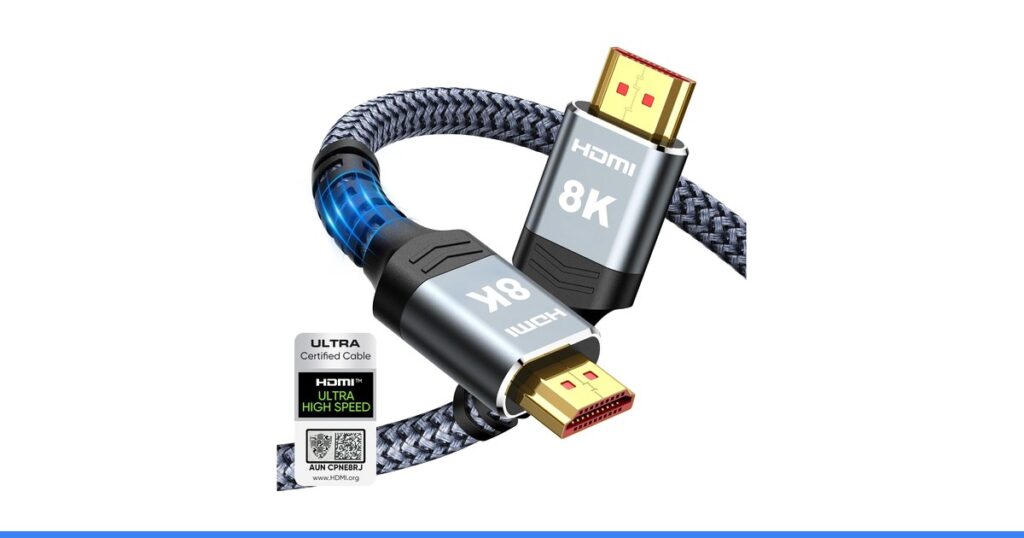
Two of the HDMI cable listings on this page publish 48Gbps and HDMI 2.1. Two publish 18Gbps and HDMI 2.0. All four sit at 4.7 stars, with between 82% and 84% of buyers giving five, so the rating tells you nothing about which is which. Across 452,619 buyer ratings, picture quality comes back a praised theme on every one of the four – 650 mentions, 611, 580 and 207. The difference is not what they are praised for. It is what they are argued about, and there the two tiers separate cleanly.
The claims, and what the record says
| The number | What it promises | What buyers report |
|---|---|---|
| Highwings 8K 48Gbps HDMI 2.1 | 48Gbps and HDMI 2.1, for 8K at 60Hz and 4K at 120Hz | Signal quality MIXED at 590 – the largest disputed theme here |
| PowerBear 4K HDMI Cable, 10ft | 18Gbps and 4K at 60Hz in the bullets – 48 Gbps in the gallery | Compatibility MIXED at 335, reliability MIXED at 331 |
| Ubluker 10K 48Gbps HDMI 2.1 | 48Gbps certified, 10K at 60Hz, 4K at 240Hz, 144Hz and 120Hz | Bandwidth support MIXED at 112 – on 4K at 120Hz exactly |
| Amazon Basics HDMI Cable, 6ft | 18Gbps and 4K at 60Hz – and a bullet saying what breaks it | One disputed theme, and the best ratio on the page at 27.16 |
How We Check a Claim
Three checks, and none of them is the star rating. First, what every record praises, because picture quality is positive on all four regardless of the number on the box. Second, which theme each record disputes rather than how many – a cable argued about for durability and a cable argued about for signal are different purchases. Third, everything normalised per 1,000 buyers, because the largest crowd here is nearly eight times the smallest and raw counts would just track sales.
Myth 1: Highwings 8K 48Gbps HDMI 2.1

The cable advertising the most bandwidth is the one whose buyers argue about the signal. Picture quality is praised at 650 mentions, the highest figure on this page – and signal quality comes back mixed at 590, with some buyers reporting no issues and others the signal cutting in and out.
What the listing promises
Its bullets describe an 8K Ultra High Speed HDMI 2.1 cable supporting 48Gbps, compatible with 8K at 60Hz and 4K at 120Hz, backward compatible down to HDMI 1.1, with a braided cord and an anti-bending tail. It is sold as certified ultra high speed and its packaging carries the HDMI certification label.
What the review record says
4.7 stars from 45,619 ratings with 83% of buyers at five stars. Five themes praised: quality at 2,600 mentions, value for money at 894, picture quality at 650, compatibility at 552 and build quality at 428. Three disputed, more than anything else on this page: signal quality mixed at 590, purchase at 366 and flexibility at 312, where some buyers like the cord and others find it too firm. Its praise-to-dispute ratio is 4.04, the lowest here.
What to check instead
Hold two facts together: its picture quality figure is the highest on this page, and its signal is the most argued-about thing on this page. Both are its own record.
Seen on Highwings 8K 48Gbps HDMI 2.1 (example product) — 4.7 stars from 45,619 ratings.
Myth 2: PowerBear 4K HDMI Cable, 10ft

Its bullets cap it at 4K@60Hz, say it supports 18Gbps transfer and state plainly that it is NOT for 8K. Its third gallery image, read at full size, ticks a checklist box marked 48 Gbps and another marked 120 Hz. Same page, two different figures.
What the listing promises
Its bullets describe 4K video at 60Hz, 2K and 1080p, 48-bit colour, TrueHD 7.1, ARC and Ethernet; 30AWG copper, triple tin shielded, in a double braided nylon jacket with gold plated connectors; 18Gbps transfer and backwards compatibility down to HDMI 1.3, explicitly NOT for 8K; and 10 feet, the longest cable on this page.
What the review record says
4.7 stars from 87,560 ratings with 83% of buyers at five stars and 0% at two. Six themes praised: quality at 3,200 mentions, value for money at 1,400, durability at 1,000 – the only record on this page where durability comes back positive – picture quality at 611, length at 425 and flexibility at 278. Two disputed, and neither is about bandwidth: compatibility mixed at 335, where it works with some laptops and TVs but not with some monitors, and reliability mixed at 331. Ratio 10.38.
What to check instead
Read the bullets, then read the gallery, then notice that they disagree. Its record disputes compatibility and reliability – not the bandwidth either figure claims.
Seen on PowerBear 4K HDMI Cable, 10ft (example product) — 4.7 stars from 87,560 ratings.
Myth 3: Ubluker 10K 48Gbps HDMI 2.1

Its product title prints 4K 240Hz 144Hz 120Hz. Its review record carries bandwidth support as a mixed theme at 112 mentions, with some buyers reporting they achieve full 4K at 120Hz and others noting it is not capable of it. The mode in the name is the mode being argued about.
What the listing promises
Its bullets describe an officially certified HDMI cable with a certification label on the package, 48Gbps bandwidth, and a resolution list running 10K at 60Hz, 8K at 60Hz, 5K at 144Hz and 4K at 240Hz, 120Hz and 144Hz, plus eARC, ARC and the high-bitrate audio formats.
What the review record says
4.7 stars from 35,572 ratings with 84% of buyers at five stars – the highest five-star share on this page by a single point. Six themes praised: quality at 1,000 mentions, functionality at 824, value for money at 278, picture quality at 207, connectivity at 164 and build quality at 136. Two disputed: bandwidth support mixed at 112 and durability mixed at 110, where some buyers say it is built to last and others report it failing after a week. Ratio 11.75, second best here.
What to check instead
When a resolution and refresh rate appear in the product name, check whether the record argues about that exact mode. On this one it does.
Seen on Ubluker 10K 48Gbps HDMI 2.1 (example product) — 4.7 stars from 35,572 ratings.
Myth 4: Amazon Basics HDMI Cable, 6ft

Its sixth bullet reads: this cable supports up to 4K@60Hz, so if a connected device’s output is higher than that standard, the cable won’t work properly. No other listing on this page states a failure mode. It also carries the fewest disputed themes here – one – and the largest crowd by far.
What the listing promises
Its bullets describe an A-male-to-A-male cable, 6 feet, supporting 4K video at 60Hz, 2160p, 48-bit colour, bandwidth up to 18Gbps, Ethernet, 3D and ARC, backwards compatible with earlier HDMI versions – and then a sixth bullet stating the ceiling and what happens above it.
What the review record says
4.7 stars from 283,868 ratings, by a wide margin the biggest crowd on this page, with 82% of buyers at five stars and 1% at one. Seven themes praised, the most here: functionality at 5,700 mentions – the largest praised theme anywhere on this page – value for money at 3,000, compatibility at 933, picture quality at 580, reliability at 567, length at 455 and build quality at 443. One disputed theme, durability, mixed at 430, where some buyers report it has never failed and others that it broke after a month. Ratio 27.16.
What to check instead
A listing that names its own ceiling is doing something the others are not. Check the ceiling against your kit – above 4K at 60Hz, this listing says it will not work.
Seen on Amazon Basics HDMI Cable, 6ft (example product) — 4.7 stars from 283,868 ratings.
What to Read Instead
Here is the pattern, and it is narrower than ‘specs lie’. The only two records on this page that dispute anything to do with the signal or the bandwidth are the two cables advertising 48Gbps: the Highwings on signal quality at 590 mentions, where buyers report the signal cutting in and out, and the Ubluker on bandwidth support at 112, where buyers disagree about whether it reaches 4K at 120Hz. Neither 18Gbps cable carries a theme of that kind anywhere on its record. They are argued about too – the Amazon Basics on durability, the PowerBear on compatibility and reliability – but not about the signal. So three habits. Read which theme is disputed, not how many. Be wary of a figure printed in a product title, because the Ubluker’s title says 4K at 120Hz and that is exactly what its buyers contradict each other about. And read the gallery at full size against the bullets: the PowerBear’s bullets cap it at 18Gbps and say NOT for 8K, while its own third gallery image ticks a box marked 48 Gbps. One thing this page does not claim: that the ranking splits by tier. It does not. Best to worst runs 18Gbps, 48Gbps, 18Gbps, 48Gbps. What does hold is that the tidiest record here belongs to the lowest-spec cable, which is what we found reading monitor specs too.
Cable bandwidth is not the only networking number that oversells itself: our USB to Ethernet adapter comparison shows the same gap between a port’s rating and what it delivers, and our USB WiFi adapter comparison puts the only WiFi 6 model last. The pattern itself is in our tech specs guide.
Frequently Asked Questions
Do I need a 48Gbps HDMI cable?
Only if the devices at both ends can use it – and this page cannot tell you that, because nothing in these records tests it. What it can tell you is that picture quality is a praised theme on all four cables here, at 18Gbps and at 48Gbps alike, and that all four sit at 4.7 stars. The one thing that separates the tiers is which complaint each record carries. Both 48Gbps cables have a disputed theme about the signal or the bandwidth – the Highwings on signal quality at 590 mentions, the Ubluker on bandwidth support at 112. Neither 18Gbps cable has anything of that kind. That is not evidence that the higher-spec cables are worse cables; it is evidence that their buyers end up arguing about the thing the box advertises.
Does a better HDMI cable improve picture quality?
On these four records, picture quality is praised whatever the cable claims – 650 mentions on the Highwings, 611 on the PowerBear, 580 on the Amazon Basics and 207 on the Ubluker. Not one of the four has picture quality as a disputed theme. That is worth sitting with: across 452,619 ratings and two bandwidth tiers, the picture is the thing nobody is complaining about. What buyers do complain about varies by cable – durability on one, compatibility and reliability on another, the signal on the two 48Gbps ones.
Which HDMI cable has the best review record?
The Amazon Basics 6ft, and by a distance. It carries seven praised themes – functionality at 5,700 mentions, value for money at 3,000, compatibility at 933, picture quality at 580, reliability at 567, length at 455 and build quality at 443 – against a single disputed theme, durability at 430, for a praise-to-dispute ratio of 27.16. The others run 11.75 on the Ubluker, 10.38 on the PowerBear and 4.04 on the Highwings. Note what that order is not: it is 18Gbps, 48Gbps, 18Gbps, 48Gbps from best to worst, so the ranking does not split by bandwidth tier even though the signal complaints do.
Why does one listing say 18Gbps and 48Gbps on the same page?
We do not know, and we are only reporting what is there. The PowerBear listing’s first bullet says it supports 4K video at 60Hz; its third says it supports 18Gbps transfer and is NOT for 8K. Read at full size, its third gallery image carries a green-ticked feature checklist, and two of the ticks read 48 Gbps and 120 Hz. Those are the same listing telling you two different things. We left that image off our deck – it is also a side-by-side against an unnamed rival – and we are flagging it here because it is the clearest argument on this page for reading the bullets rather than the pictures.
Are these cables reliable?
Nobody has settled it on any of them, which is unusual. There are eight disputed themes across these four records and every single one is mixed rather than an outright negative – meaning buyers contradict each other rather than agree. The Amazon Basics has one, durability at 430 mentions. The Ubluker has two, bandwidth support at 112 and durability at 110. The PowerBear has two, compatibility at 335 and reliability at 331. The Highwings has three, signal quality at 590, purchase at 366 and flexibility at 312. No agreed fault anywhere on the page, which also means none of this is proof that any of them lasts.
What actually matters in this category
Researched from real buyer evidence by the Technocastel editorial team — last reviewed 22 August 2026.
Read which theme a record disputes, not how many. The only two cables here whose buyers argue about the signal are the two advertising 48Gbps. A cable argued about for durability and a cable argued about for signal are different purchases, even at the same star rating.
Treat a figure in a product title as a claim to check rather than a specification to trust. The Ubluker’s title prints 4K at 240Hz, 144Hz and 120Hz, and 4K at 120Hz is precisely the mode its buyers contradict each other about on its own review record.
Read the gallery against the bullets, at full size. One listing here caps itself at 18Gbps and 4K@60Hz in text while ticking a box marked 48 Gbps in a picture. Neither is hidden – they are just in different places on the same page, and only one of them is the specification.
A listing that tells you what it cannot do is worth more than one that does not. The lowest-spec cable here is the only one stating a failure mode – above 4K@60Hz it says it will not work properly – and it also carries the fewest disputed themes and the best ratio on the page.
Related guides
- For a listing that states its own number two different ways, and the one that promised least coming out cleanest, read our monitor spec check
- For another published figure that turned out not to sort the record, see our immersion blender comparison
- For four more numbers that are true and still misleading, read our tech spec check
How this article was made. The ranking comes from the public review record — rating counts, star distributions and the themes owners repeat — tallied with software, then read, judged and written up by Abdelaziz Sabbah. We do not lab-test these products and no brand pays for placement; our full method is here. Review counts are a floor at the date above and prices change, so confirm both on the retailer’s page before you buy. As an Amazon Associate we earn from qualifying purchases — affiliate disclosure.