
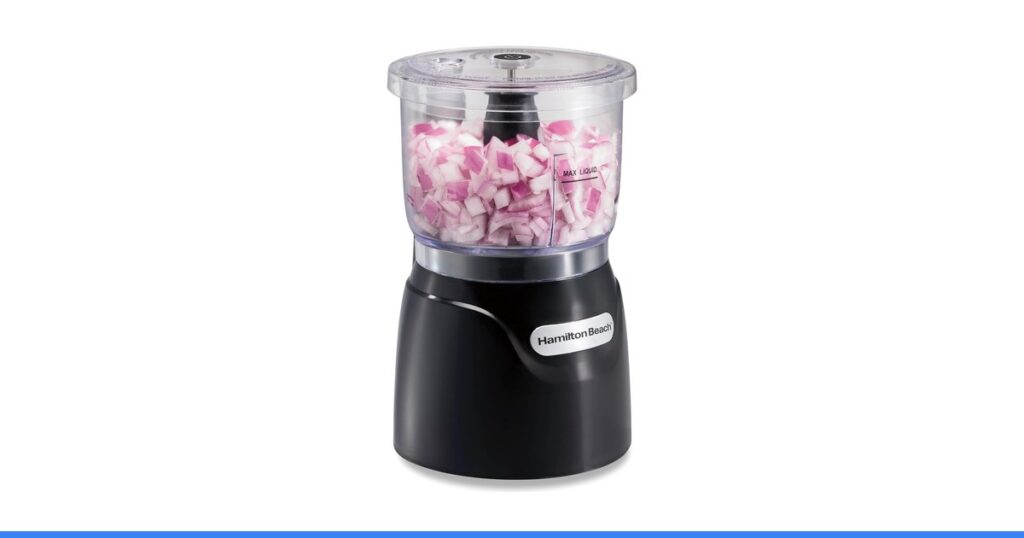
Put the two biggest-selling mini chopper records side by side and the first thing you notice is how much they agree on. Across 68,055 buyer ratings, four themes come back praised on both: size, ease of cleaning, power and speed. Both machines chop, both wash up, both feel strong for how small they are. Then there is one theme where they do not agree at all, and it is not the one you would guess. On the Hamilton Beach, ease of use is the largest theme on the page and it is praised – 1,600 mentions. On the KitchenAid, the same theme comes back mixed at 795, with some buyers finding it easy and others saying it is too difficult to operate. Whether the thing is pleasant to work is what separates these two.
Quick Comparison
| Rank | Food choppers | Key Spec | Best For | Rating |
|---|---|---|---|---|
| 1 | Hamilton Beach 3 Cup Electric Vegetable Chopper & Mini Food Processor | 3 cups | You want the record with the fewest disputes and the larger crowd | 4.6 (37,143) |
| 2 | KitchenAid 3.5 Cup Food Chopper KFC3516CU, Contour Silver | 3.5 cups | You want the bigger bowl, two speeds and a pulse setting | 4.5 (30,912) |
Our Top Pick
Hamilton Beach 3 Cup Electric Vegetable Chopper & Mini Food Processor wins because every measure in its record goes its way, and unlike most duels on this site the margins are not small. 4.6 stars against 4.5, from 37,143 ratings against 30,912. 81% of buyers at five stars against 79%, and 3% at one star against 5%. Seven themes praised against six, led by ease of use at 1,600 mentions, size at 1,500, ease of cleaning at 1,300, chopping performance at 1,100, value for money at 1,100, power at 739 and speed at 732. Normalised that is 217.3 praise mentions per 1,000 buyers against 181.0, and 12.9 complaint mentions per 1,000 against 36.1 – a gap of 2.8 times – for a praise-to-dispute ratio of 16.81 against 5.01. One measure goes the other way, and it is below.
#1 Hamilton Beach 3 Cup Chopper — Best On The Record

Rating: 4.6 out of 5 from 37,143 ratings | Key spec: 3 cups
4.6 stars from 37,143 ratings – the larger crowd here, though only by 20% – with 81% of buyers at five stars and 3% at one. Seven themes come back praised, led by ease of use at 1,600 mentions, which is the largest theme on this page: size at 1,500, ease of cleaning at 1,300 where buyers count only three pieces to wash, chopping performance at 1,100, value for money at 1,100, power at 739 and speed at 732. Normalised, 217.3 praise mentions per 1,000 buyers and 12.9 complaint mentions per 1,000, for a ratio of 16.81. The listing describes a 3 cup bowl, a 350 watt motor – the only wattage figure stated across either of these two listings – stainless steel blades, an oil dispenser on the lid, and a bowl, lid and removable blades that are all dishwasher safe. Its first bullet sells the absence of a lock: stack the lid on top of the bowl, press to run, release to stop, and no difficult twist-locking is needed. Its one disputed theme is durability at 480 mentions, where some buyers say it lasts a long time and others report it breaking after a few uses – and per 1,000 buyers that dispute is the louder of the two here.
What We Like
- 1,600 on ease of use: The largest theme on this record, and the thing its listing leads with
- 1,500 on size: Plus 1,300 on ease of cleaning – buyers count only three pieces to wash
- 1,100 on chopping: Plus 1,100 on value, 739 on power, 732 on speed – seven praised themes
What Could Be Better
- 480 on durability – mixed: Some buyers say it lasts a long time; others report it breaking after a few uses
- 12.9 per 1,000 on durability: Louder per buyer than the KitchenAid’s 10.4 – the one measure that goes the other way
- The smaller bowl, 3 cups: Half a cup less than its rival, and its listing names no speed settings at all
Check the Hamilton Beach on Amazon
#2 KitchenAid 3.5 Cup Food Chopper — Best For Capacity

Rating: 4.5 out of 5 from 30,912 ratings | Key spec: 3.5 cups
4.5 stars from 30,912 ratings with 79% of buyers at five stars and 5% at one, and six praised themes: performance at 2,000 mentions – the largest single theme anywhere in this comparison – functionality at 1,500, compact size at 872 where buyers say it suits two people, ease of cleaning at 555, power at 351 and speed at 318. That works out at 181.0 praise mentions per 1,000 buyers against the Hamilton Beach’s 217.3, with 36.1 complaint mentions per 1,000 against 12.9, for a ratio of 5.01. The bowl holds 3.5 cups, about 17% more than its rival and the one place this chopper leads on paper, and the listing adds two speeds plus pulse, a drizzle basin for adding liquid while it runs, a cord wrap, and a work bowl that features a locking blade which locks in place for pouring. Its bullets state no wattage at all, and power is praised anyway. Two themes are disputed. Ease of use at 795 mentions, where some buyers find it easy and others say it is too difficult to operate. And durability at 322 mentions, where some report three years without breaking and others the lid breaking on first use.
What We Like
- 2,000 on performance: The largest single theme in this duel, with 1,500 more on functionality
- 872 on its compact size: Buyers say it suits two people; ease of cleaning adds 555 mentions
- 351 on power: Plus 318 on speed – praised for its size, though its bullets state no wattage
What Could Be Better
- 795 on ease of use – mixed: Some buyers find it easy to use; others say it is too difficult to operate. Its rival’s record praises this.
- 36.1 complaints per 1,000: Against 12.9 on the Hamilton Beach – a 2.8x gap, on a crowd only 17% smaller
- 322 on durability – mixed: Some report three years without breaking; others report the lid breaking on first use
Check the KitchenAid on Amazon
How We Chose These Food choppers
Three tests. First, what both crowds praise, because four themes come back positive on both records and that covers most of what a mini chopper is for. Second, the single theme they split on. Third, the thing neither record settles – durability, which is mixed on both of these and on a third chopper we captured and did not ship. Every rate here is normalised per 1,000 buyers, because one crowd is 20% larger than the other and raw theme counts would simply track that.
For a kitchen category where the durability complaint is agreed rather than disputed, read our coffee maker report. For another kitchen listing whose durability claim its own record argues with, see our electric kettle comparison. For a duel where the two records refused to separate at all, read our charging station duel.
Which One Should You Buy?
Buy the Hamilton Beach 3 Cup if you want the record with fewer arguments in it: the better rating, the better five-star share, the higher praise rate, a complaint rate 2.8 times lower and seven praised themes, on 20% more ratings. Its listing describes a 350 watt motor, a bowl, lid and removable blades that are all dishwasher safe, and a lid you press to run and release to stop. Buy the KitchenAid 3.5 Cup in two cases. If the extra half cup of bowl matters – it is the one place the KitchenAid leads on paper, and it is a real 17% more room. And if you want control over the texture, because it offers two speeds and a pulse setting where the Hamilton Beach listing names no speed settings at all. Go in knowing that ease of use is the theme its own buyers argue about.
Frequently Asked Questions
Which mini chopper has the better review record?
The Hamilton Beach 3 Cup, on every measure but one, and by margins that are not small. It holds 4.6 stars from 37,143 ratings against the KitchenAid 3.5 Cup’s 4.5 from 30,912, with 81% of buyers at five stars against 79% and 3% at one star against 5%. It carries seven praised themes against six. Normalised it draws 217.3 praise mentions per 1,000 buyers against 181.0, and 12.9 complaint mentions per 1,000 against 36.1 – a gap of 2.8 times – for a praise-to-dispute ratio of 16.81 against 5.01. The one measure that goes the other way is the durability dispute, which is louder on the Hamilton Beach per buyer: 12.9 mentions per 1,000 against 10.4.
Is the KitchenAid mini chopper hard to use?
Its buyers do not agree. Ease of use comes back mixed on the KitchenAid record at 795 mentions, with the review summary reporting that some customers find it easy to use and others say it is too difficult to operate. Mixed means exactly that – a theme buyers argue about rather than one they agree on. On the Hamilton Beach the same theme is praised, at 1,600 mentions, and it is the largest theme on that record. That contrast is the whole reason this comparison exists, because on the four themes praised on both – size, cleaning, power and speed – there is very little to choose between them.
Does the locking bowl explain the difference?
We do not know, and neither record tests it. What we can report is what each listing says and what each crowd says, side by side. The Hamilton Beach listing sells the absence of a lock: its first bullet says that since all you do is stack the lid on top of the bowl, no difficult twist-locking is needed – and its buyers praise ease of use more than anything else on the page. The KitchenAid listing sells a work bowl that features a locking blade, and a blade that locks in place for convenient pouring – and its buyers dispute ease of use. That is two products. It is a pairing, not a mechanism, and nothing in either review record joins the two facts. We are stating both and stopping there.
Do mini food choppers break?
Buyers cannot agree, and that is the finding. Durability is a mixed theme on both of these – 480 mentions on the Hamilton Beach, 322 on the KitchenAid – and it is mixed again on the third chopper we captured, the Cuisinart Mini-Prep Plus, at 602 mentions across 24,778 ratings. Not one of the three carries an outright negative anywhere in its record. Each summary carries both halves in a single sentence: some say it lasts long, others report it breaking after a few uses; some report three years without breaking, others the lid breaking on first use; many find it durable, some report it breaking after two uses. That is different from what we found across four coffee makers in our coffee maker report, where durability was an outright negative on all four and buyers agreed with each other.
Is the bigger bowl worth it?
It is the one place the KitchenAid leads on paper – 3.5 cups against 3, which is about 17% more room – and it is the reason to choose it if you regularly fill the bowl. The KitchenAid also gives you two speeds and a pulse setting, where the Hamilton Beach listing names no speed settings at all and describes pressing the lid to run and releasing to stop. What the extra capacity does not buy is a better record: on praise per 1,000 buyers the KitchenAid trails 181.0 to 217.3, and its complaint rate is 2.8 times higher. Buy it for the bowl and the speeds, not for the reviews.
Final Thoughts
Sixty-eight thousand buyers across two mini choppers, and most of what they say is the same. Size, cleaning, power, speed – praised on both. The split is about operating the machine, and it is wide: praised 1,600 times on one record, disputed 795 times on the other. There is one more thing worth carrying away from this page, and it is the reason a third chopper was captured. On all three, durability comes back mixed – never an outright negative. These buyers are not agreeing that mini choppers break. They are contradicting each other, sometimes inside a single sentence: three years without breaking, or the lid breaking on first use. A mixed theme is an argument, not a verdict, and it is worth reading as one.
Check the Hamilton Beach on Amazon
What actually matters in this category
Researched from real buyer evidence by the Technocastel editorial team — last reviewed 22 August 2026.
Read whether a complaint is mixed or negative before you read how big it is. Durability is mixed on both of these choppers and on a third we captured, which means buyers contradict each other rather than agree on a fault. Three years without breaking and the lid breaking on first use are both in the same record. A mixed theme is an argument, not a verdict.
Normalise before you compare. One of these crowds is 20% larger than the other, so raw theme counts partly measure how many people bought the thing. Per 1,000 buyers the praise runs 217.3 against 181.0 and the complaints run 12.9 against 36.1 – and the second gap is far wider than the star ratings, 4.6 against 4.5, would ever suggest.
Say the measure that goes against your own conclusion. The chopper that wins this comparison carries the louder durability dispute of the two per buyer: 12.9 mentions per 1,000 against 10.4. It still wins, because every other measure goes its way by more. Hiding the one that does not would have made the case look cleaner than it is.
A listing claim and a review record agreeing is worth noticing, because it is rarer than the reverse. One of these sells the absence of a twist-lock and its buyers praise ease of use above everything else on the page. The other sells a locking bowl and its buyers dispute ease of use. Two products is a pairing, not a mechanism – we are not claiming the lock is the cause, only that the claim and the record point the same way in each case.
Related guides
How this article was made. The ranking comes from the public review record — rating counts, star distributions and the themes owners repeat — tallied with software, then read, judged and written up by Abdelaziz Sabbah. We do not lab-test these products and no brand pays for placement; our full method is here. Review counts are a floor at the date above and prices change, so confirm both on the retailer’s page before you buy. As an Amazon Associate we earn from qualifying purchases — affiliate disclosure.