
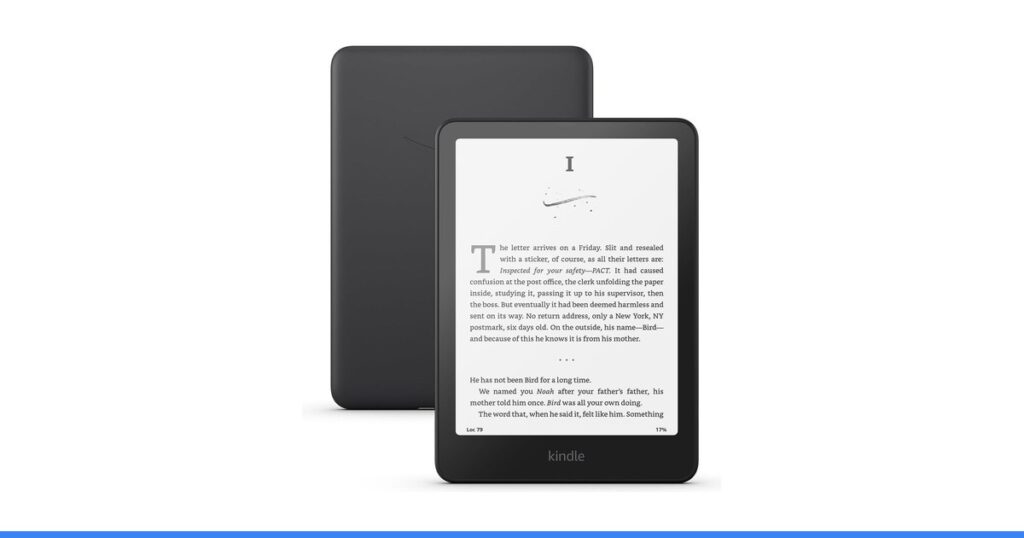
This kindle vs kindle paperwhite comparison puts the two best-selling Kindles side by side across 42,382 buyer ratings, and the result is unusually tidy. Seven themes come back praised on each device, and each one has exactly one theme its buyers argue about. What makes it worth reading is that the two disputed themes mirror each other. Battery life is praised on the Paperwhite at 725 mentions and disputed on the base Kindle at 690. Colour runs the other way: praised on the base Kindle at 558 and disputed on the Paperwhite at 496.
Quick Comparison
| Rank | Kindles | Key Spec | Best For | Rating |
|---|---|---|---|---|
| 1 | Amazon Kindle Paperwhite 16GB (newest model) – 20% faster, with new 7in glare-free display and weeks of battery life – Black | 7-inch, 16 GB | You want battery life praised rather than argued about | 4.6 (22,485) |
| 2 | Amazon Kindle 16 GB (newest model) – Lightest and most compact Kindle, now with faster page turns, and higher contrast ratio – Matcha | 6-inch, 16 GB | You want the one buyers call one-handed and take everywhere | 4.5 (19,897) |
Our Top Pick
Amazon Kindle Paperwhite 16GB (newest model) – 20% faster, with new 7in glare-free display and weeks of battery life – Black wins because the theme that flips its way is the one you cannot change. Seven themes come back praised: enjoyment at 2,300 mentions – the largest single theme in this comparison, by a clear 500 – with battery life at 725, value for money at 677, size at 626, usability at 576, weight at 565 and speed at 544. Against that sits exactly one disputed theme, the display colour at 496 mentions, where some buyers love the soft tone and others dislike it. That is 6,013 mentions of praise against 496 disputed, a ratio of 12.1 to 1, across 22,485 ratings. It also holds the better figure on all three headline numbers: 4.6 stars against 4.5, 83% of buyers at five stars against 80%, and 4% at one star against 5%.
#1 Kindle Paperwhite 16 GB — The Wider Margin

Rating: 4.6 out of 5 from 22,485 ratings | Key spec: 7-inch, 16 GB
4.6 stars from 22,485 ratings, the deeper record here, with 83% of buyers at five stars and only 4% at one. Enjoyment leads at 2,300 mentions – the largest single theme in this comparison – with battery life at 725, value for money at 677, size at 626, usability at 576, weight at 565 and speed at 544. That is 6,013 praised mentions against 496 disputed, a ratio of 12.1 to 1. The listing quotes a 7-inch glare-free display with 25% faster page turns, up to 12 weeks on a single USB-C charge, waterproofing, and a display that adjusts from white to amber. Its one disputed theme is that display’s colour at 496 mentions, where some buyers love the soft tone and others dislike it.
What We Like
- 2,300 on enjoyment: The largest single theme in this duel, by a margin of 500
- 725 on battery life: Praised here – and the disputed theme on the base Kindle
- 12.1 per disputed one: 6,013 praised mentions against 496 disputed, the wider margin
What Could Be Better
- 496 on display colour: Mixed – some love the soft tone, others dislike it
- 267 praised per 1,000: Against 331 on the base Kindle, and on the bigger crowd
- Size praised 2.0x less: Per 1,000 buyers: 27.8 here against 55.3 on the base
Check the Paperwhite on Amazon
#2 Kindle 16 GB — The Higher Praise Rate

Rating: 4.5 out of 5 from 19,897 ratings | Key spec: 6-inch, 16 GB
4.5 stars from 19,897 ratings, with 80% of buyers at five stars. Performance leads at 1,800 mentions, then size at 1,100, weight at 772 and portability at 751 – three separate themes all describing the same quality – with value for money at 744 and colour at 558, which its summary attributes to the soft green shell. Per 1,000 buyers that is 331 mentions of praise against 267 on the Paperwhite, and size alone is raised roughly twice as often. The listing calls it the lightest and most compact Kindle, with a 6-inch glare-free display, a front light it says is 25% brighter at maximum, and up to 6 weeks of battery. That last figure is the one its buyers dispute, at 690 mentions.
What We Like
- 1,800 on performance: Its largest theme – page turns are the listing’s headline change
- 1,100 on size: Plus 772 on weight and 751 on portability – three themes, one idea
- 331 praised per 1,000: The higher praise rate in this duel, against 267 on the rival
What Could Be Better
- 690 on battery life: Mixed – amazing for some, terrible for others, in the same record
- 4.5 stars, 5% at one: Against 4.6 stars and 4% at one on the Paperwhite
- 9.6 praised per disputed: Against 12.1 on the Paperwhite – the narrower margin here
How We Chose These Kindles
Three tests, in order. First, the disputed theme, because each of these has exactly one and they are not the same one – and one of the two is a setting you can move while the other is not. Second, the mirror: whether the thing one device is argued about for is the thing the other is praised for, which here happens twice. Third, mentions per 1,000 buyers, because the two crowds are close in size – 22,485 and 19,897 – but the praise rates are not, at 267 against 331.
For another head-to-head where two themes swap sides, read our Soundcore vs Bose duel. For the battery question one of these leaves open, see our power bank comparison. For reading what a listing is actually claiming, read the tech specs that lie guide.
Which One Should You Buy?
Buy the Kindle Paperwhite 16 GB if you read for long stretches and want the battery question settled: it is praised at 725 mentions here and argued about at 690 on the base Kindle, and the listings put up to 12 weeks against up to 6. It is also the one that is waterproof, per its listing. Buy the base Kindle 16 GB if what matters is carrying it – its summary describes a device that fits comfortably in one hand and suits reading on the go, and its buyers raise size at 1,100 mentions, weight at 772 and portability at 751, which is three separate themes about the same quality. Per 1,000 buyers it also collects more praise than the Paperwhite, 331 against 267. What you accept with it is a battery its own buyers cannot agree on.
Frequently Asked Questions
Is the Kindle Paperwhite worth it over the basic Kindle?
On this review record, yes, and for one specific reason. Both devices collect seven praised themes and exactly one disputed theme, but the Paperwhite’s disputed theme is the display’s colour tone at 496 mentions, which its own listing says adjusts from white to amber. The base Kindle’s disputed theme is battery life at 690 mentions, which no setting changes. The Paperwhite also holds 4.6 stars against 4.5, 83% of buyers at five stars against 80%, and a praise-to-dispute ratio of 12.1 against 9.6.
Does the basic Kindle have bad battery life?
Its buyers do not agree, which is exactly what a disputed theme means. Battery life carries 690 mentions on the base Kindle and Amazon marks it mixed – the summary notes some owners find it amazing while others report terrible performance. The listing quotes up to 6 weeks on a charge. The Paperwhite quotes up to 12, and on that device battery life comes back praised at 725 mentions rather than argued about.
What is the difference between the Kindle and Kindle Paperwhite?
Per the two listings: the base Kindle has a 6-inch glare-free display and quotes up to 6 weeks of battery, and is described as the lightest and most compact Kindle. The Paperwhite has a 7-inch glare-free display, quotes up to 12 weeks on a USB-C charge, is waterproof, and its display adjusts from white to amber. Both hold 16 GB. The review records differ too, and not in the direction the specs suggest.
Which Kindle do buyers praise more?
The base Kindle, once you normalise. The Paperwhite has the deeper crowd at 22,485 ratings against 19,897, but per 1,000 buyers the base Kindle collects 331 mentions of praise against 267. The gap is widest on size, praised 55.3 times per 1,000 buyers on the base Kindle against 27.8 on the Paperwhite – roughly double – with weight at 1.5x and value for money at 1.2x. The smaller device is talked about more per buyer.
Why compare two Kindles instead of two brands?
Because this is the comparison buyers actually make, and because the two records happen to mirror each other. Each device has exactly one theme its owners argue about, and on each one that theme is something the other device gets praised for – battery life one way, colour the other. One note on that second pair: the two colour themes are not about the same part. The base Kindle’s is the shell, described in its summary as a soft green. The Paperwhite’s is the display’s warmth.
Final Thoughts
Two Kindles, 42,382 ratings, seven praised themes each, and scores that barely separate them – 4.6 against 4.5, with 83% and 80% of buyers at five stars. What separates them is which single thing their owners cannot agree on. On the Paperwhite it is the display’s colour, and its own listing says that display adjusts from white to amber. On the base Kindle it is battery life, and no setting fixes that. When two products in the same family each carry one complaint, the useful question is not which complaint is louder. It is whether you can do anything about it.
Check the Paperwhite on Amazon
What actually matters in this category
Researched from real buyer evidence by the Technocastel editorial team — last reviewed 22 August 2026.
Ask whether a complaint is a setting or a limitation. Both Kindles here carry exactly one disputed theme, but only one of them can be adjusted. The Paperwhite’s display colour runs from white to amber by its own listing; the base Kindle’s battery life is what it is. Same shape of complaint, very different consequence.
Normalise per 1,000 buyers even when the crowds look similar. These two are only 2,588 ratings apart, which feels close enough to compare raw – and yet the praise rates come out 331 against 267. Rating counts that differ by a tenth can still move a comparison once you divide through.
Watch for the same word attached to different parts of a product. Colour is a theme on both devices here. On the base Kindle it means the shell, praised at 558 mentions. On the Paperwhite it means the display’s warmth, disputed at 496. Reading those two as one theme would have reversed the conclusion.
Finally, compare the shape of a record, not only its score. Seven praised themes and one disputed theme is the same shape on both of these devices, which is why the star ratings sit so close together. The difference only appears when you ask which theme landed in the disputed column.
Related guides
How this article was made. The ranking comes from the public review record — rating counts, star distributions and the themes owners repeat — tallied with software, then read, judged and written up by Abdelaziz Sabbah. We do not lab-test these products and no brand pays for placement; our full method is here. Review counts are a floor at the date above and prices change, so confirm both on the retailer’s page before you buy. As an Amazon Associate we earn from qualifying purchases — affiliate disclosure.