
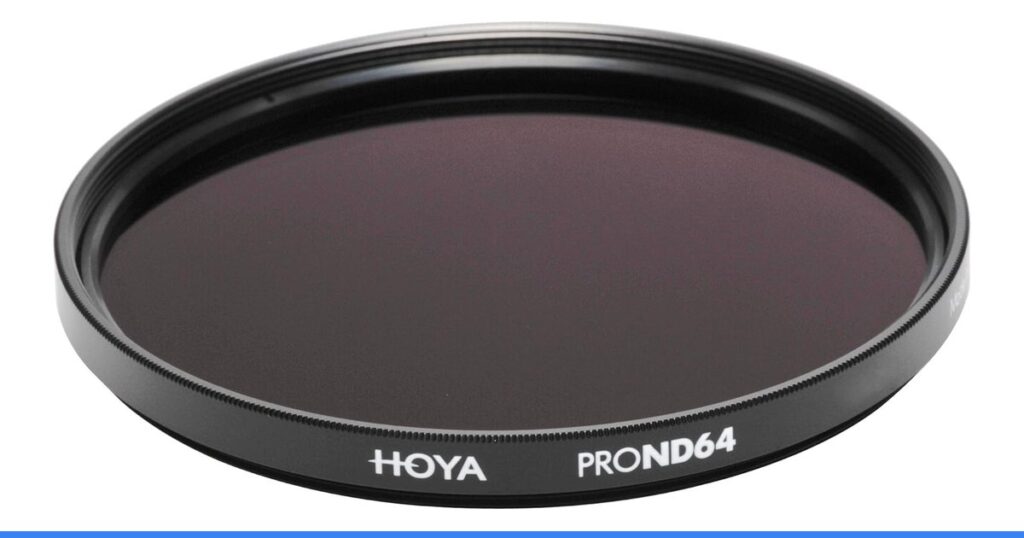
A neutral density filter does one job: it cuts the light reaching the sensor so you can use a slower shutter in daylight. Across 600+ ratings averaging 4.6 stars, the Hoya Pro ND64 has something unusual – not a single mixed or negative theme. It also has a very thin record, and a name that two different kinds of buyer read two different ways. Both are worth a minute before you order.

The record at a glance
| What we measured | What the record says |
|---|---|
| Rating | 4.6 stars from 600+ ratings |
| Star distribution | 79% five-star, 11% four, 3% three, 4% two, 3% one-star |
| Biggest praised theme | exposure — 19 mentions |
ND64 is six stops, not sixty-four of them
The 64 in the name is how much light the filter blocks as a fraction: it passes one sixty-fourth of what hits it. In photographic terms that is six stops, and Hoya’s own feature list says so plainly. Buyers who want the long, glassy water effect in bright sun are usually reaching for ten stops, which is an ND1000 – a different filter that blocks a thousandth of the light. We flag this because the review record itself contains an owner describing ten true stops from this filter, and the listing does not support that. Six stops is plenty for softening a waterfall or shooting wide open in daylight; it is not enough to turn a midday sea into mist.
| The listing says | Owners report |
|---|---|
| Reduces the light entering your lens by 6 stops | Exposure is the largest praised theme at 19 mentions – the strength does what the listing says |
| ACCU-ND coating for truly neutral colour balance | Colour accuracy is praised 11 times, with owners reporting no colour cast |
| Low-profile aluminium ring avoids vignetting | Image quality draws 5 praised mentions; nothing in the record reports vignetting |
What owners praise
- exposure — 19 mentions
- color accuracy — 11 mentions
- image quality — 5 mentions
- value for money — 5 mentions
Every theme on this record is positive, which almost never happens. Exposure leads at 19 mentions, colour accuracy at 11, image quality at 5 and value for money at 5. A 79% five-star share is the strongest in this batch of reviews. Owners consistently report no colour cast and no vignetting – the two faults that make a cheap ND filter worthless.
What owners dispute
There is no mixed theme and no negative theme here, so instead we will point at the real weakness of this record: it is thin. Forty themed mentions across 640 ratings is a small sample, and a clean sheet drawn from a small sample is weaker evidence than a messy one drawn from thousands. The 4% at two stars and 3% at one have no theme attached to explain them, which means we cannot tell you what went wrong for those buyers. Treat this as encouraging rather than settled.
Should you buy it?
Buy it if: you want a six-stop filter that will not tint your photographs, and this is the right thread size for your lens. On colour neutrality – the thing cheap filters get wrong – the record has no complaints at all.
Skip it if: you are chasing long daylight exposures of a minute or more. That is ten-stop territory and this filter is six, so you would be buying the wrong tool and blaming it afterwards.
Check the Hoya Pro ND64 on Amazon
Frequently Asked Questions
How many stops is the Hoya Pro ND64?
Six. The 64 describes the light reduction as a fraction – it passes one sixty-fourth of the light – and six stops is the photographic equivalent. Hoya states this in the product’s own feature list.
Will it add a colour cast?
The record says no. Colour accuracy is praised in 11 mentions with owners specifically reporting no casts, and nothing on the record disputes it. That is the main reason to buy a branded ND rather than the cheapest one available.
Which size do I need?
This one is 62mm, and filter sizes are not interchangeable. The number is printed on your lens barrel or inside the lens cap next to a circle with a line through it. Ordering the wrong thread size is the most common mistake in this category.
Is it enough for silky water in daylight?
For a waterfall in shade or an overcast afternoon, yes. For smooth water in bright midday sun you want ten stops, which means an ND1000. Six stops will get you a fraction of a second where you wanted several seconds.
What actually matters in this category
Researched from real buyer evidence by the Technocastel editorial team — last reviewed 12 September 2026.
Filter names describe a ratio, not an effect, and that is where the money gets wasted. ND8 passes an eighth of the light, which is three stops. ND64 passes one sixty-fourth, which is six. ND1000 passes about a thousandth, which is ten. Each step of three stops is eight times more light blocked, so the gap between ND64 and ND1000 is far bigger than the names suggest.
Work backwards from the shutter speed you want rather than forwards from a product name. If your scene meters at a two-hundredth of a second and you want half a second, that is about seven stops and no six-stop filter will get you there. This arithmetic takes ten seconds and prevents the most common disappointment in the category.
Then judge the glass on colour. Any filter can block light; the expensive part is blocking all wavelengths equally so your photographs do not come back tinted, and that is exactly what the coating name on a filter like this one is selling. A clean colour record is the single best reason to pay more.
Last, be careful with thin review records. Forty themed mentions is a hint rather than a verdict, and a product with nothing bad said about it may simply be a product few people have written about in detail. We would rather tell you the sample is small than pretend it is unanimous.
Related guides
- For another camera number that means less than it sounds, read our megapixels guide
- Long exposures need something to hold the camera still: our phone tripod comparison
- For the wider habit of reading a listing’s numbers properly: our tech specs guide
How this article was made. The ranking comes from the public review record — rating counts, star distributions and the themes owners repeat — tallied with software, then read, judged and written up by Abdelaziz Sabbah. We do not lab-test these products and no brand pays for placement; our full method is here. Review counts are a floor at the date above and prices change, so confirm both on the retailer’s page before you buy. As an Amazon Associate we earn from qualifying purchases — affiliate disclosure.