
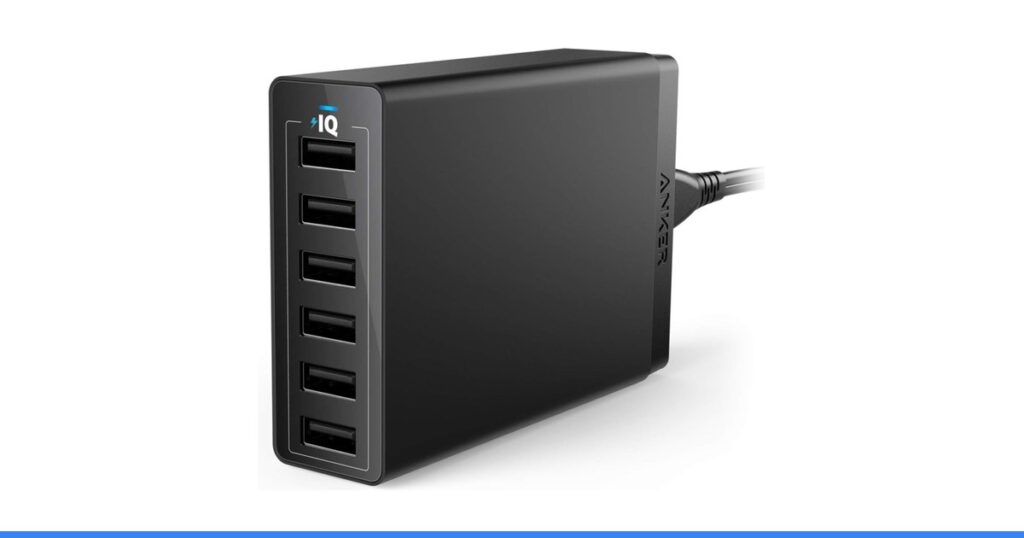
One charging station on this page claims 60 watts. The other claims 252 – more than four times as much – across four USB-C ports and four USB-A. Across 37,642 buyer ratings, their review records refuse to reflect that. Both hold exactly seven praised themes. Both are faulted for exactly one thing, and on both it is the same question: whether the unit keeps working. Neither carries an outright negative anywhere. Normalised, they land within four per cent of each other – 476.1 praise mentions per 1,000 buyers against 458.1. So the record is not what separates these two. The ports are.
Quick Comparison
| Rank | Chargers | Key Spec | Best For | Rating |
|---|---|---|---|---|
| 1 | Anker Desktop Charger, 60W 6 Port USB Multiple Charging Hub | 6 USB-A | You charge phones over USB-A and want the deeper record here | 4.8 (27,222) |
| 2 | SABRENT VOLTIK Charging Station, 252W 8-Port USB C and USB A, LCD Display | 4C + 4A | You need USB-C, or you want to see what each port is drawing | 4.7 (10,420) |
Our Top Pick
Anker Desktop Charger, 60W 6 Port USB Multiple Charging Hub wins because every measure in its record goes its way, and it does so on two and a half times the crowd. 4.8 stars against 4.7, from 27,222 ratings against 10,420. 87% of buyers at five stars against 84%, and 1% at one star against 2%. Seven praised themes led by quality at 4,800 mentions – the largest theme on this page – functionality at 2,900, charging speed at 1,800, charging capacity at 1,200, ports at 876, convenience at 702 and compact size at 682. Normalised that is 476.1 praise mentions per 1,000 buyers against 458.1, with 26.8 complaint mentions per 1,000 against 32.2, for a praise-to-dispute ratio of 17.75 against 14.21. Every one of those margins is small. All of them point the same way.
#1 Anker PowerPort 6 — Best On The Record

Rating: 4.8 out of 5 from 27,222 ratings | Key spec: 6 USB-A
4.8 stars from 27,222 ratings – two and a half times the crowd on the other side of this comparison – with 87% of buyers at five stars and 1% at one. Seven themes come back praised, the same number as its rival but deeper: quality at 4,800 mentions, the largest theme on this page, functionality at 2,900, charging speed at 1,800, charging capacity at 1,200, ports at 876, convenience at 702 and compact size at 682. Normalised, 476.1 praise mentions per 1,000 buyers and 26.8 complaint mentions per 1,000, for a ratio of 17.75. Six USB-A ports on a 60 watt total, up to 2.4 amps per port or 12 amps cumulative through PowerIQ and VoltageBoost, with UL certification, a 5ft detachable cord and an 18-month warranty – and the listing states itself that Qualcomm Quick Charge is not supported. Two things temper it. Its one disputed theme is reliability at 730 mentions, while its own first bullet sells reliable performance and enduring quality. And the word USB-C does not appear in its title or its bullet points at all.
What We Like
- 4,800 on quality: The largest theme on this page, plus 2,900 on functionality
- 1,800 on charging speed: Plus 1,200 on charging capacity and 876 on ports
- 702 on convenience: And 682 on compact size – seven praised themes in all
What Could Be Better
- 730 on reliability: Mixed – and its own bullet sells reliable performance and enduring quality
- No USB-C anywhere: Not in its title, not in its bullets – six USB-A ports only
- 60W total, 2.4A a port: Under a quarter of the wattage its rival claims
#2 SABRENT VOLTIK — The One With USB-C

Rating: 4.7 out of 5 from 10,420 ratings | Key spec: 4C + 4A
4.7 stars from 10,420 ratings with 84% of buyers at five stars, and seven praised themes: quality at 1,700 mentions, functionality at 1,000, charging speed at 626, charging capability at 546, value for money at 357, port count at 277 and compatibility at 267. That works out at 458.1 praise mentions per 1,000 buyers against the Anker’s 476.1 – a gap of under four per cent – with 32.2 complaint mentions per 1,000 against 26.8, for a ratio of 14.21. Four USB-C and four USB-A ports share one 252W budget, and the listing does the arithmetic for you: a single USB-C port can reach 100W, each USB-C pair shares up to 125W, USB-A ports give 18W each, and power drawn by one device reduces what is left for the others. A colour LCD cycles through all eight ports showing live wattage, voltage, amperage and internal temperature. It also warns that very low-draw accessories may not draw power reliably from a high-wattage port. Against it: durability, mixed at 336 mentions, where some owners report it stopping inside two years.
What We Like
- 1,700 on quality: Its largest praised theme, plus 1,000 on functionality
- 626 on charging speed: Plus 546 on charging capability and 277 on port count
- 267 on compatibility: Seven praised themes in all – the same number as its rival
What Could Be Better
- 336 on durability: Mixed – some owners report it stopped working inside two years
- 458.1 praise per 1,000: Behind the Anker’s 476.1, though by under four per cent
- The smaller crowd here: 10,420 ratings against 27,222 on the Anker
Check the SABRENT 252W on Amazon
How We Chose These Chargers
Three tests. First, the record normalised per 1,000 buyers, because one of these has two and a half times the crowd of the other and raw theme counts would simply track that. Second, what each one is actually faulted for, which turns out to be a single theme apiece – and the same question on both. Third, what the ports can physically do, because that is the one place where these two are nothing like each other.
For why a headline wattage is a total shared across ports, read our car charger comparison. For a charging category where the failure is shared and agreed on, see our wireless charger report. For charging away from an outlet entirely, read our power bank comparison.
Which One Should You Buy?
Buy the Anker PowerPort 6 if the devices you charge take USB-A: it holds the better rating, the better five-star share, the better praise rate, the lower complaint rate and the better ratio, on the deeper crowd, and its six ports deliver up to 2.4 amps each. Buy the SABRENT VOLTIK in three cases. If anything you own charges over USB-C – a laptop, a recent phone or tablet – because the Anker listing does not mention USB-C in its title or its bullet points at all, so the better-reviewed product here simply cannot do the job. If you want to see what is happening, because the SABRENT’s colour LCD reports live wattage, voltage, amperage and internal temperature for each of its eight ports. And if you need real power for a laptop, because a single USB-C port on it can reach 100W where the Anker’s entire unit is rated at 60.
Frequently Asked Questions
Which charging station has the better review record?
The Anker PowerPort 6, on every measure available and by a small margin on each. It holds 4.8 stars from 27,222 ratings against the SABRENT VOLTIK’s 4.7 from 10,420, with 87% of buyers at five stars against 84% and 1% at one star against 2%. Normalised it draws 476.1 praise mentions per 1,000 buyers against 458.1, and 26.8 complaint mentions per 1,000 against 32.2, for a praise-to-dispute ratio of 17.75 against 14.21. Both hold exactly seven praised themes. The gap is real and it is consistent, but it is under four per cent on the praise rate, which is why the ports end up mattering more than the ranking.
Does the Anker PowerPort 6 have USB-C?
Its listing does not mention USB-C anywhere we captured – not in the product title and not in any of its bullet points. What it describes is six USB ports delivering up to 2.4 amps each or 12 amps cumulatively, from a 60 watt total, using Anker’s PowerIQ and VoltageBoost, and it states separately that Qualcomm Quick Charge is not supported. The SABRENT VOLTIK, by contrast, puts four USB-C and four USB-A ports on one 252W budget. If anything you need to charge uses USB-C, that difference decides this comparison regardless of which record is stronger.
What is a 252W charging station actually giving each device?
The SABRENT listing spells this out itself, which is unusual. A single USB-C port can reach 100W on its own, each USB-C pair shares up to 125W, and USB-A ports deliver up to 18W each – and, in its own words, power drawn by one device reduces what is left for the others. So 252W is a shared budget rather than a per-port figure. We found the same structure across the car charger market in our car charger comparison. What is different here is that the brand volunteers the arithmetic instead of leaving the headline number to speak for itself, and its LCD then shows you the split in real time.
Do desktop charging stations stop working?
It is the only thing either of these is faulted for, and on both it is a mixed theme rather than a negative one – meaning buyers contradict each other rather than agree. On the Anker it is reliability at 730 mentions, where many report no issues and some report a single port failing after two weeks. On the SABRENT it is durability at 336 mentions, where some report it still running strong and others report it stopping inside two years. Neither product has an outright negative theme anywhere in its record, which is not something we can say about every category we have covered.
Why does this comparison only cover two charging stations?
Because it is a duel, and because the two other candidates we captured did not belong on the page. One is a 5-port station with 10,491 ratings that carries the only outright negative in the whole set – durability at 379 mentions, where owners report its plastic dividers breaking – plus four further disputed themes; it is also a cable-and-organiser product rather than a charger of this class. The other holds 9,656 ratings and 4.4 stars but has no aspect themes and no review summary at all, so there is nothing to compare. Rating count is not review depth. Both are named here rather than quietly dropped.
Final Thoughts
Thirty-seven thousand buyers across two charging stations, and one claims more than four times the power of the other. The review records will not tell you that. Seven praised themes each. One disputed theme each, and on both it is whether the thing keeps working. No outright negatives on either. 476.1 praise mentions per 1,000 buyers against 458.1. When two records are that close, the record has stopped being the tiebreaker and the hardware starts being it – and the plain summary of this page is that the better-reviewed unit is the one that cannot charge a USB-C laptop.
What actually matters in this category
Researched from real buyer evidence by the Technocastel editorial team — last reviewed 22 August 2026.
When two records are this close, stop using the record as the tiebreaker. These two land within four per cent of each other on praise per 1,000 buyers, hold seven praised themes apiece, and are each faulted for exactly one thing. At that point the specification you can verify – what the ports are – tells you more than the ranking does.
Check what a listing does not say. The better-reviewed product here does not mention USB-C in its title or any of its bullet points, and for a lot of buyers that single absence outweighs every margin in its favour. An absence is harder to notice than a claim, which is exactly why it is worth looking for.
Give credit when a listing discloses its own limits. One of these publishes how its total wattage divides between ports, states plainly that power drawn by one device reduces what is left for the others, and warns that very low-draw accessories may not charge reliably from a high-wattage port. That is a brand telling you where its product stops working, before you buy it.
Finally, read whether a complaint is mixed or negative. Both of these are faulted for the same thing – whether the unit keeps working – and on both it comes back mixed, which means buyers contradict each other rather than agree on a fault. Neither carries an outright negative anywhere.
Related guides
How this article was made. The ranking comes from the public review record — rating counts, star distributions and the themes owners repeat — tallied with software, then read, judged and written up by Abdelaziz Sabbah. We do not lab-test these products and no brand pays for placement; our full method is here. Review counts are a floor at the date above and prices change, so confirm both on the retailer’s page before you buy. As an Amazon Associate we earn from qualifying purchases — affiliate disclosure.