
Every car charger on this page leads on a wattage figure, and they run from 40W to 130W – more than three times apart. That number is a total shared across the ports, not what a single device receives. The WODENTA listing does the arithmetic for you: its 67W is PD 37W maximum plus QC 30W maximum. The UGREEN caps one port at 45W PPS under a 130W headline. Across 21,504 buyer ratings, charging speed comes back praised on all three, so they all charge fast whatever the number says. What does move is the star rating – and on this page it moves the other way.
Quick Comparison
| Rank | Chargers | Key Spec | Best For | Rating |
|---|---|---|---|---|
| 1 | Anker 40W 2-Port PowerIQ 3.0 USB C Fast Charging Car Charger | 40W, 2 ports | You want the best record here, on the smallest claim | 4.8 (9,706) |
| 2 | WODENTA 67W Fast USB C Car Charger, 3-Port Cigarette Lighter Adapter | 67W, 3 ports | You want three ports and the split printed in the listing | 4.7 (5,948) |
| 3 | UGREEN 130W 3-Port USB C Car Charger, Type C Cigarette Lighter Adapter | 130W, 3 ports | You want the biggest headline number on this page | 4.6 (5,850) |
Our Top Pick
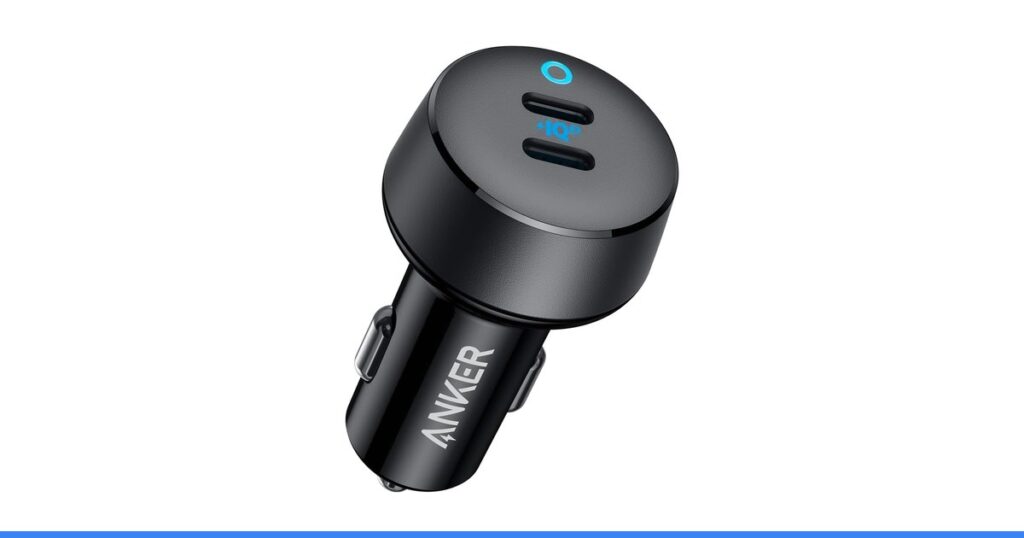
Anker 40W 2-Port PowerIQ 3.0 USB C Fast Charging Car Charger wins on the measures with the most buyers behind them. It holds 4.8 stars from 9,706 ratings – the best rating and the biggest crowd here – with 87% of buyers at five stars and only 2% at one, the lowest one-star share on this page. Charging speed leads its record at 451 mentions, larger than any single theme on either rival, with power at 119, charging capacity at 73, compatibility at 72, dual ports at 60 and compact size at 54. Nothing on its record comes back as an outright negative: its two disputed themes are reliability at 118 mentions, where some owners report failure inside two weeks, and fit at 87, where some say it does not sit snugly in the port. Its praise-to-dispute ratio of 4.04 is the narrowest here, which is worth stating plainly – it wins on distribution, not on margin.
#1 Anker 40W — Best Overall

Rating: 4.8 out of 5 from 9,706 ratings | Key spec: 40W, 2 ports
4.8 stars from 9,706 ratings – the best rating and the biggest crowd on this page – with 87% of buyers at five stars and only 2% at one, the lowest one-star share here. Charging speed leads its record at 451 mentions, larger than any single theme on either rival, with power at 119, charging capacity at 73, compatibility at 72, dual ports at 60 and compact size at 54. 40W across two ports, PowerIQ 3.0, an ultra-compact build the listing says keeps other dashboard controls reachable, and an 18-month warranty with the PowerDrive III Duo. Nothing on its record is an outright negative: reliability is mixed at 118 mentions, where some owners report failure inside two weeks, and fit is mixed at 87, where some say it does not stay snug in the port. Its 4.04 praise-to-dispute ratio is the narrowest of the three.
What We Like
- 451 on charging speed: Its largest theme, by a wide margin
- 4.8 stars, 87% five-star: The best rating and distribution on this page
- Only 2% at one star: The lowest one-star share of the three
What Could Be Better
- 118 on reliability: Mixed – some report it failing inside two weeks
- 87 on fit: Mixed – some say it does not sit snugly in the car port
- 4.04 praise ratio: The narrowest margin on this page
#2 WODENTA 67W — Highest Praise Rate

Rating: 4.7 out of 5 from 5,948 ratings | Key spec: 67W, 3 ports
4.7 stars from 5,948 ratings, with 85% at five stars and nobody at two. Normalised it draws 135.8 praise mentions per 1,000 buyers – the highest rate on this page, against 85.4 on the Anker and 43.9 on the UGREEN. Charging speed leads at 228 mentions, value for money at 225, car compatibility at 117, charging capability at 110, charging performance at 74 and cord length at 54. This is also the listing that shows its own arithmetic: 67W total across three ports, made up of PD 37W max plus QC 30W max, with a 3FT USB-C cable included rated for 60W and 480Mbps. What holds it second is the one theme on this page that comes back as an outright negative rather than an argument: reliability at 67 mentions, with owners reporting it stops working after six months. Connectivity is mixed at 74, with several reporting Apple CarPlay problems.
What We Like
- 228 on charging speed: Plus 225 on value for money – its two largest themes
- 135.8 praise per 1,000: The highest praise rate on this page
- 0% at two stars: With 85% of buyers at five
What Could Be Better
- 67 on reliability: NEGATIVE – owners report it stops working after six months
- 74 on connectivity: Mixed – several report Apple CarPlay issues
- The only negative here: Neither rival carries an outright negative theme
Check the WODENTA 67W on Amazon
#3 UGREEN 130W — Biggest Claim, Thinnest Record

Rating: 4.6 out of 5 from 5,850 ratings | Key spec: 130W, 3 ports
4.6 stars from 5,850 ratings, carrying the largest headline figure on this page by a wide margin – 130W across three ports, with the listing stating separately that the USB-C2 port supports up to 45W PPS. Two USB-C and one USB-A, pitched for MacBook, iPad, Galaxy, Steam Deck and Switch, with overheating, short-circuit, over-voltage and over-current protection, a scratch-resistant body and a soft blue LED for finding the ports in the dark. No cable is included. Quality leads its praise at 86 mentions, charging speed at 81, versatility at 27 where one owner reports running a Starlink mini while driving. But its whole theme record runs to just 296 mentions – the thinnest here by a wide margin – and 43.9 praise mentions per 1,000 buyers, the lowest on this page. Durability is mixed at 24 and heat at 15, with owners reporting it breaking after a month, running very hot, or melting after a couple of uses.
What We Like
- 86 on quality: Its largest theme – owners call it well made
- 81 on charging speed: It charges fast, like all three here
- 6.59 praise ratio: The widest margin here – on the thinnest record
What Could Be Better
- 296 theme mentions: The thinnest record on this page by a wide margin
- 43.9 praise per 1,000: Half the Anker’s rate, a third of the WODENTA’s
- 24 on durability, 15 on heat: Mixed – owners report breaking, and melting
Check the UGREEN 130W on Amazon
How We Chose These Chargers
Three tests, in order. First, what the wattage actually means, because it is a total across ports rather than a per-device figure, and one of these listings prints the split itself. Second, whether it charges fast, which turns out to be praised on all three regardless of the headline number. Third, what the review record says – the star distribution, the theme depth, and whether any theme comes back as an agreement rather than an argument.
For the wall-charger version of this same question, read our Anker vs Apple charger duel. For what goes wrong with the cable-free option, see our wireless charger report. For what holds the phone you are charging, read our car phone mount comparison.
Which One Should You Buy?
Buy the Anker 40W if you want the strongest record here: 4.8 stars, 87% of buyers at five, 2% at one, and no negative theme – accepting that it is a 2-port charger and that fit and reliability are both disputed on it. Buy the WODENTA 67W if you want three ports, a cable in the box, and the listing that shows its own 37W-plus-30W split, and you can accept the one outright negative on this page: reliability at 67 mentions, with owners reporting it stops after six months. Buy the UGREEN 130W if you want the largest total output for charging several devices at once, noting its record is the thinnest here at 296 theme mentions and that durability and heat are both disputed, with owners reporting breaking and melting.
Frequently Asked Questions
Does a higher wattage car charger charge my phone faster?
Not necessarily, because the headline figure is a total shared across the ports rather than what one device gets. The WODENTA listing spells it out: its 67W is PD 37W maximum plus QC 30W maximum. The UGREEN quotes 130W in total but states separately that its USB-C2 port supports up to 45W PPS. Charging speed comes back praised on all three records here – 451 mentions on the Anker, 228 on the WODENTA and 81 on the UGREEN – so all three charge fast regardless of which number is on the front.
Which car charger has the best review record?
The Anker 40W, on the measures with the most buyers behind them. It holds 4.8 stars from 9,706 ratings, the best rating and the biggest crowd on this page, with 87% of buyers at five stars and only 2% at one – the lowest one-star share here. It also carries no outright negative theme; its two disputed themes are reliability at 118 mentions and fit at 87. Its praise-to-dispute ratio of 4.04 is actually the narrowest of the three, so it wins on distribution rather than on margin.
Why does the lowest-wattage charger have the best rating?
On this page the two run opposite: 40W sits at 4.8 stars, 67W at 4.7 and 130W at 4.6. Three products on one page is a pattern, not a law, and we are not presenting it as one. What the records do show is that charging speed is praised on all three, so the extra watts are not buying extra satisfaction on the thing they are sold for. The differences that do appear are elsewhere – reliability, fit, heat and durability.
Is the UGREEN 130W car charger worth it?
It is the right shape if you genuinely need to charge several devices at once – its listing pitches MacBook, iPad, Steam Deck and Switch, and one owner reports running a Starlink mini while driving. But its review record is by far the thinnest on this page at 296 theme mentions, against 1,034 on the Anker and 949 on the WODENTA, and normalised it draws 43.9 praise mentions per 1,000 buyers against 85.4 and 135.8. Durability is disputed at 24 mentions and heat at 15, with owners reporting it breaking after a month or melting after a couple of uses.
Why does this comparison only cover three car chargers?
Two further candidates were captured and left out for different reasons. One held 7,309 ratings and the deepest review record of anything we pulled – but every image in its gallery beyond the first is a comparison table against an unnamed rival, a versus panel or a claim to be the category leader, and we do not put competitor tables or superlatives on a slide. The other held 4,214 ratings and carried no aspect-theme record at all, so there was nothing to compare. Rating count is not review depth.
Final Thoughts
Twenty-one thousand buyers across three car chargers, and the number every listing leads on is a total the ports share between them. Charging speed is praised on all three, so the question was never whether they charge fast. What separates them is the record, and on this page it runs opposite to the claim: 40W at 4.8 stars, 67W at 4.7, 130W at 4.6. Three products on one page is a pattern rather than a law, and we are not claiming otherwise. But it is the opposite of what the big number on the front is sold to suggest, and it is worth reading the per-port figure before paying for the total.
What actually matters in this category
Researched from real buyer evidence by the Technocastel editorial team — last reviewed 22 August 2026.
Read the per-port figure, not the total on the front. A car charger’s headline wattage is what the whole unit can deliver with every port in use, not what your phone receives. One listing here prints its own split – 37W plus 30W makes the 67W – and another caps a single port at 45W under a 130W headline.
Check whether the thing the spec is sold for is even in dispute. Charging speed is praised on all three of these records, which means the wattage number is not buying a difference in the outcome it advertises. Where every product satisfies on a dimension, that dimension cannot rank them.
Separate a disputed theme from an agreed one. Two of these three carry only arguments – owners contradicting each other about fit, reliability, heat. One carries an agreement: reliability marked negative, with owners reporting the same six-month failure. That distinction does more work than any figure on the packaging.
Finally, weigh theme depth before trusting a ratio. The thinnest record on this page has the widest praise-to-dispute margin, simply because there is so little of it – 296 mentions against 1,034. A flattering ratio computed on a small number of themes is not the same evidence as a narrower one computed on a large number.
Related guides
How this article was made. The ranking comes from the public review record — rating counts, star distributions and the themes owners repeat — tallied with software, then read, judged and written up by Abdelaziz Sabbah. We do not lab-test these products and no brand pays for placement; our full method is here. Review counts are a floor at the date above and prices change, so confirm both on the retailer’s page before you buy. As an Amazon Associate we earn from qualifying purchases — affiliate disclosure.